Best Padel Rackets for All-Court Players (2026): Versatility, Transition, and Fast Net Exchanges
The best all-court padel rackets in 2026 help you defend, transition, volley quickly, and still finish short balls. Use this guide to choose by transition speed, forgiveness, firmness, and balance.
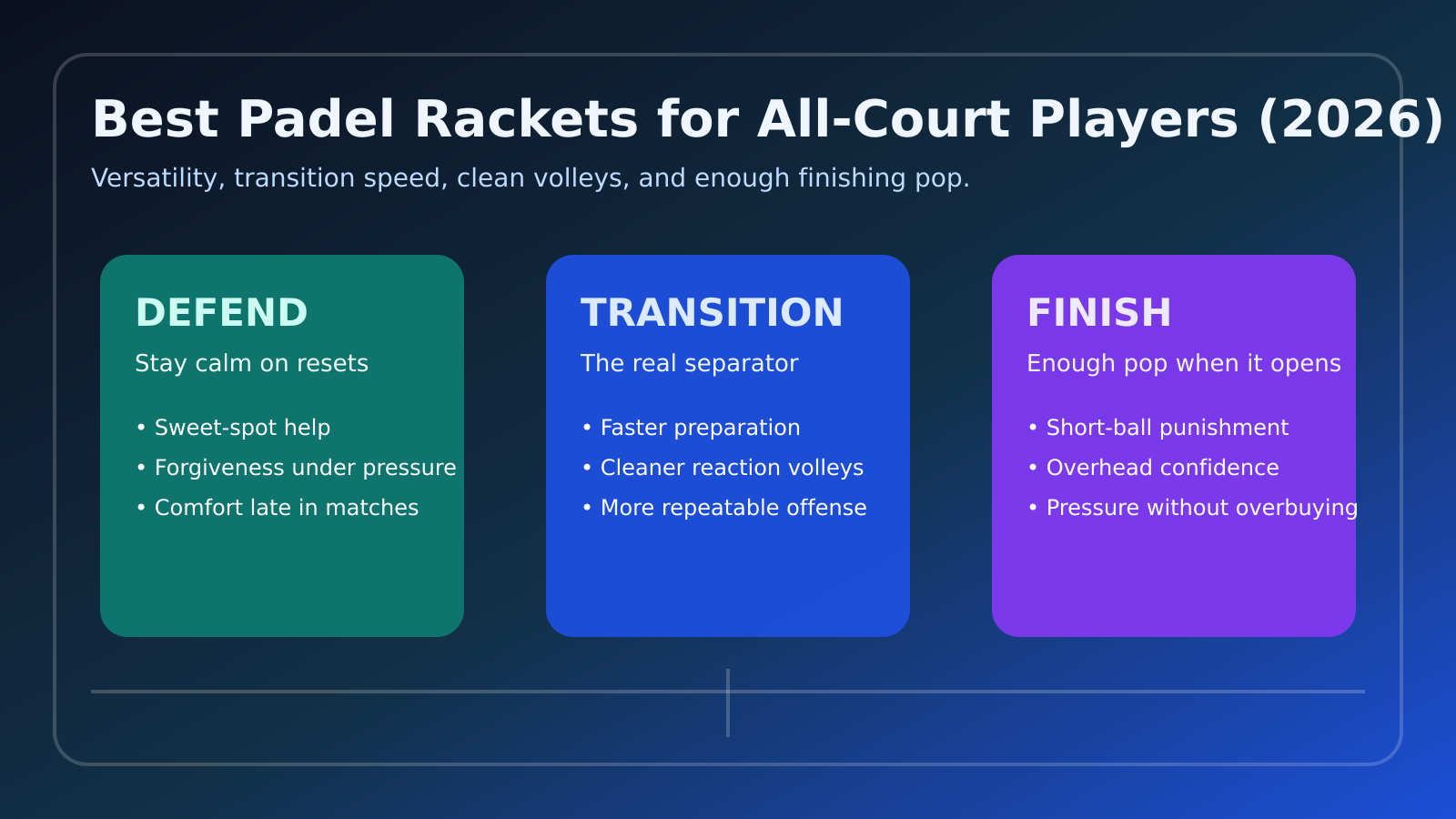
Updated for August 2026.
Quick answer
If you want the short version, start here:
- The best all-court racket in 2026 is usually a teardrop or hybrid-shaped frame that helps you defend, transition quickly, volley cleanly, and still finish short balls.
- For many buyers, the smartest live examples are the Babolat Air Viper 2.6, the NOX AT10 Genius 18K Alum 2026, and balanced family options like the Wilson Blade lane.
- If you remember one thing, make it this:
choose your transition speed before you chase pure power.
Affiliate disclosure
Some links in this guide are affiliate links. If you buy through them, we may earn a commission at no extra cost to you.
What all-court really means in padel
An all-court racket is not a bland middle ground.
It is the racket for the player who has to do a little bit of everything well:
- defend without feeling rushed
- move forward quickly when the ball gets short
- survive fast hand exchanges at the net
- reset from awkward positions
- still finish points when the opening is real
That is why this category matters so much.
A lot of club players are not pure left-side finishers. A lot are not pure right-side builders either. They are mixed-role players, doubles players who switch gears during rallies, or improving players who want one racket that does not box them into a single identity.
If you already know you are much more extreme than that, compare this logic with our guide to best padel rackets for left-side players or our guide to best padel rackets for right-side players. But if your real match play lives in the space between those two lanes, all-court is probably where you should start.
Why teardrop and hybrid rackets keep showing up in all-court conversations
There is a reason so many versatile-racket conversations keep landing in the teardrop and hybrid lane.
Babolat’s own overview of teardrop padel racquets describes the shape around versatility and a balance between power and control. That is exactly what most all-court buyers are chasing.
You want more punch than a pure round control frame usually gives.
But you also want more forgiveness and easier transitions than the harshest diamond power rackets tend to offer.
That is why teardrop keeps making sense:
- the sweet spot usually sits in a more forgiving middle ground
- the racket still gives you enough overhead help to punish short balls
- you keep more hand speed for quick exchanges and reaction volleys
- you usually get a more realistic blend of defense and attack over a full match
If you want the deeper geometry explanation, our guide to round vs teardrop vs diamond padel racket shape is the best place to go next.
Choose your transition speed before you chase pure power
This is the biggest buying mistake in the whole category.
A lot of players shop all-court rackets by asking one question first:
Which one gives me the most power?
That is often backwards.
The better question is:
Which one gets into position quickly enough that I can actually use my offense more often?
That is what transition speed really means.
It is not just raw racket speed. It is how easily the racket lets you:
- recover from defense
- prepare early at the net
- react on quick volleys
- accelerate without feeling late
- stay dangerous when the point turns messy
If the racket slows your hands, shrinks your margin too much, or makes you feel late on reaction volleys, you will not reach the power you paid for often enough.
That is why a lot of all-court players end up playing better with something like the Babolat Air Viper 2.6 than with a heavier, harsher power frame. Babolat explicitly sells the Air Viper around maneuverability, reactivity, and smoother transitions between defense and attack. For real all-court players, that is not a side detail.
It is the whole point.
The four filters that matter before you buy
1) Balance and swing weight
This is the first real fork.
A racket can look balanced on paper and still feel demanding if the swing burden is too high for your hands and timing.
All-court buyers usually do best when the racket gives them enough stability to feel solid at the net, but not so much burden that they start arriving late.
If you already know weight and late-match handling change your game a lot, our guide to best padel rackets by weight is the right companion read.
2) Sweet-spot forgiveness
A true all-court racket should help you on imperfect contact.
That matters because all-court players do not live only on perfect overheads. They block, react, half-volley, reset, and counter from awkward positions.
If your racket only feels good when you are set early and swinging cleanly, it is probably leaning too far away from real all-court usefulness.
3) Firmness and comfort tolerance
Firm is not always better.
A firmer racket can feel cleaner and more direct when timing is right, but it can also become more tiring, more punishing, and less forgiving when points get rushed.
That is one reason the NOX AT10 Genius 18K Alum 2026 is such a useful reference point. NOX explicitly positions its MLD Black EVA around helping both defensive shots and finishing shots, which is exactly the compromise a lot of all-court players want.
4) Finishing pop vs repeatability
You still need enough pop to punish short balls.
But that is not the same thing as needing the harshest smash-first racket in the shop.
For most all-court players, the better question is not:
How much power can this racket produce at its best?
It is:
How often can I reach that offense without making the rest of padel harder than it needs to be?
Best all-court racket lanes in 2026
| Player type | Best lane | 2026 examples | Why it works | Main tradeoff |
|---|---|---|---|---|
| Speed-first all-court player | maneuverable teardrop / hybrid | Babolat Air Viper 2.6 | quick prep, fast hands, easier transition play | less brute-force ceiling than pure power frames |
| Balanced premium do-it-all buyer | controlled-versatility teardrop | NOX AT10 Genius 18K Alum 2026 | strong mix of defense, volley confidence, and finishing support | premium rackets still need honest fit on firmness and weight |
| Brand-family all-court buyer | all-court bridge lane | Wilson Blade family logic | easy way to choose balance before drifting into full attack or full control | not the most extreme identity inside the brand |
| Attack-leaning all-court player | quicker offensive bridge | HEAD Coello Motion | keeps more offensive identity without the full flagship tax | still more attack-led than the calmest all-court lane |
Best options by player profile
Balanced club player who defends well but still wants to finish short balls
This is probably the biggest real-world audience.
You are not trying to play passive padel.
You just do not want a racket that makes defense, transitions, and quick volleys harder than they need to be.
This is where the NOX AT10 Genius 18K Alum 2026 makes so much sense. NOX explicitly calls it multipurpose, keeps it in a teardrop lane, and frames its core around both defensive help and finishing power.
That is what a real all-court buyer should want to hear.
Tennis convert who wants more margin than a pure power frame
A lot of tennis converts are tempted to buy attack-first rackets too early.
That makes sense emotionally.
It is often wrong in actual padel.
Most tennis converts still need more help with resets, glass defense, and faster reaction volleys than they expect. That is why a speed-first all-court option like the Babolat Air Viper 2.6 can be a smarter bridge than a harsher power frame.
If this sounds like you, our guide to the best padel racket for tennis players switching is the right next read.
Right-side or mixed-role doubles player who values quick hands and transition speed
This player does not always want a pure control racket.
If you win a lot of points through hand speed, early preparation, counters, and sharp volleys, you may still want an all-court racket that gives you enough pop to finish opportunities without slowing your reactions.
That is where the all-court lane can be smarter than going straight into a control-only story. And if you want to see that contrast more clearly, our right-side racket guide helps show where the line really is.
Improving player who wants one racket that can grow with a more complete game
This is the buyer who should be most careful about overbuying.
A racket that looks serious on paper can still slow down improvement if it makes you late, tired, or tense.
For many improving players, the smartest path is a teardrop or hybrid racket that lets them learn a fuller game first: defend better, transition earlier, volley cleaner, and only then add more attack burden if their style genuinely grows into it.
That is why brand-family bridge options like the Wilson Blade lane are so useful. They make it easier to stay in a balanced lane instead of jumping from safe beginner gear straight into the harshest attack story.
When all-court is smarter than copying pro or left-side-only gear
This is where a lot of buyers save themselves money.
All-court is the smarter choice when:
- you are not a true left-side finisher most of the time
- your wins come from cleaner transitions and better volleys, not only raw overhead force
- you still need real defensive margin when the rally gets ugly
- you want one racket that makes sense across mixed doubles roles and changing match tempos
- you know your game is broader than a highlight-reel power identity
If your game truly lives in the attack lane, go read the left-side guide.
But if you keep bouncing between “I still need easier defense” and “I still want enough offense,” that is usually your answer.
You are probably an all-court buyer.
How to narrow your shortlist in 60 seconds
If you want the fast version, answer these five questions:
Where do I actually spend most of my points — left side, right side, or mixed?
Mixed usually points toward all-court.
Do I attack through faster transitions or through heavier contact?
Faster transitions usually mean a smarter teardrop or hybrid starting point.
How much firmness do I genuinely like?
If you already know harsh rackets wear you down, do not ignore that.
How important are quick volleys and hand speed to my game?
If the answer is “very,” do not trade that away too early.
Do I want a racket that feels best in perfect highlight shots, or one that helps me more often in messy points?
That question usually tells the truth fast.
If you still feel split after that, narrow your choice by side-of-court tendency, transition speed, firmness tolerance, volley priority, and comfort needs. That is the cleanest way to move toward the right all-court lane.
If you already know your lane
If you just want to search the path that fits your game, these are the most useful next steps:
- Search best all-court padel racket 2026 on Amazon
- Search best versatile padel racket 2026 on Amazon
- Search best teardrop padel racket 2026 on Amazon
- Search hybrid padel racket 2026 on Amazon
- Search balanced padel racket for club players on Amazon
FAQ
Is an all-court padel racket just for intermediate players?
No. A lot of intermediates do well with all-court rackets, but so do many advanced club players who want one racket that helps them defend, transition, volley, and still finish without strong weaknesses.
Are teardrop rackets best for all-court players?
They are often the safest starting point because they usually sit between pure round control and pure diamond power. That makes them a natural fit for players who want versatility instead of extremes.
Is a right-side player better off with all-court or pure control?
It depends on how they win points. If they care mostly about resets, lobs, and rally control, pure control can make more sense. If they still rely on quick volleys, counters, and punishing short balls, all-court is often the better lane.
What is the best all-court padel racket for a tennis convert?
A lot of tennis converts do well with faster, more forgiving all-court options before they move into harsher power frames. The Babolat Air Viper 2.6 is a strong example of that kind of bridge.
When should I skip all-court and buy a power-first racket?
Skip all-court when your real game is clearly attack-first: you mostly play left side, already handle higher swing burden well, and genuinely win points through heavier overhead pressure rather than transition speed and mixed-role versatility.
Final verdict
The best all-court padel racket in 2026 is usually the one that lets you do more things well under real match pressure.
That means:
- enough forgiveness to defend cleanly
- enough hand speed to transition and volley fast
- enough pop to finish openings without forcing a pure power identity
For many real buyers, that points toward a teardrop or hybrid lane first.
And for a lot of club players, the smartest racket is not the one that looks most aggressive.
It is the one that helps them play complete padel more often.